Bioinformatics
We investigate RNA structure and function from sequence data and explore the mechanisms of life through genome analysis.
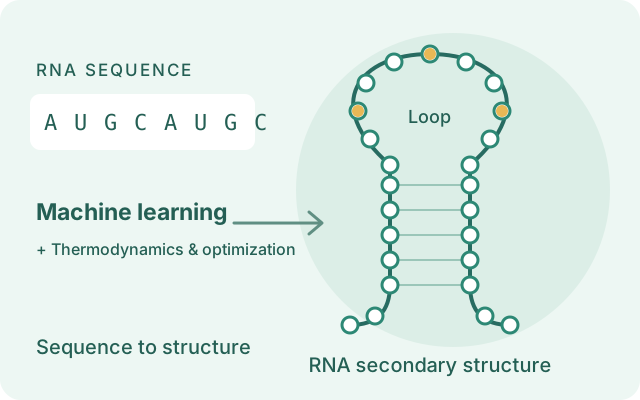
- Data
- RNA sequences, genome sequences, and sequencing data
- Methods
- Deep learning, thermodynamic models, and integer programming
- Goal
- Predict structure and function to support our understanding of biological processes
On this page
Life science produces large amounts of data, including DNA and RNA sequences. Extracting meaningful information requires both biological knowledge and computational methods. We develop machine learning methods and algorithms that address questions in life science.
Predicting the shape of RNA
RNA does more than carry instructions for making proteins: it also plays diverse roles, including the regulation of gene expression. One clue to its function is its secondary structure, which describes which nucleotides form base pairs. We study methods for predicting this structure from an RNA sequence.
MXfold2: integrating thermodynamics into deep learning
Deep learning can capture patterns in data, but prediction accuracy may decline when an RNA differs from those used for training. MXfold2 integrates structure scores learned by a deep neural network with a thermodynamic model of RNA stability. During training, it also encourages consistency with thermodynamics to improve the robustness of predictions for previously unseen RNAs. We evaluated the method in settings that include RNA families absent from the training data.
Publication: Sato et al., 2021 · Web server · Source code · Press release (Japanese)
IPknot: predicting complex structures in long RNAs
Some RNAs contain pseudoknots, structures whose base-pairing relationships cross when drawn along the sequence. Accounting for these structures increases the number of possible combinations and makes prediction computationally challenging. IPknot uses base-pairing probabilities and integer programming to predict structures that include pseudoknots. We have also introduced faster computation and automatic parameter selection to extend its application to long sequences, such as mRNAs and viral RNAs.
Publication: Sato et al., 2011 · Sato & Kato, 2022 · Web server · Source code · Press release (Japanese)
New prediction approaches and RNA–RNA interactions
Our research also explores treating RNA secondary structure prediction as multiple multi-class classification problems, allowing structures to be predicted without complex post-processing (Yang et al., 2025). Beyond individual RNAs, we have studied how two RNAs interact and contributed to the design of molecular switches composed of interacting RNAs (Kato et al., 2017; Taneda et al., 2021).
Assembling and comparing genomes
By assembling and comparing sequencing data, we can investigate the characteristics of organisms and the functions of their genes. Our work combines the development of analysis methods with the analysis of biological data through collaborative research.
- Comparative genomics of natto bacteria: We used long-read sequencing to determine genome sequences and compared strains isolated from fermented foods in Japan and other countries (Kamada et al., 2014; 2015).
- Common marmoset genome analysis: We improved genome assemblies and gene annotations, providing bioinformatics support for research on disease models generated through genome editing (Sato et al., 2015; 2016).
- Tools for sequence analysis: We contributed to XGenovo and MetaVelvet-SL, which assemble sequences from mixtures of organisms, and to the sequence alignment tool LAST (Afiahayati et al., 2013; 2015; Kiełbasa et al., 2011).
Connecting prediction with discovery
Predictions of RNA structures and interactions help narrow down hypotheses for experimental testing and provide clues to molecular function. Together with genome analysis, these methods form computational foundations for understanding biological processes and for RNA-targeted drug discovery.