Medical AI
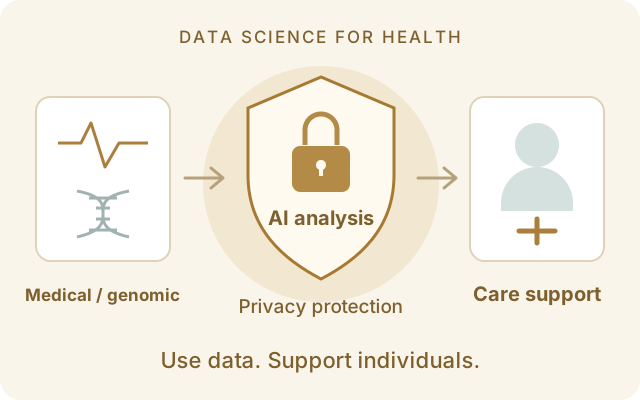
We aim to use medical and genomic data to support personalized healthcare and develop AI methods that protect privacy.
- Data
- Health and medical data, including medical images and genomic information
- Methods
- Image processing, machine learning, and privacy-preserving technologies
- Goal
- Support prevention, clinical care, and healthcare tailored to individuals
On this page
Medical images and genomic information contain clues to understanding health and disease. Through machine learning methods that extract knowledge from these data, we aim to support healthcare professionals’ decisions and contribute to care tailored to each individual. The following sections describe the research directions we seek to pursue.
Supporting prevention and clinical care through collaboration
Maintaining health requires technologies that support prevention and early detection, as well as treatment. We study ways to capture patterns in medical data through image processing and machine learning, with the aim of providing information useful in clinical care.
We emphasize analysis guided by needs in medical practice. By working with healthcare professionals, we seek to understand which information can help their decisions and to develop medical–engineering collaborations that support diagnostic accuracy and clinical work.
Connecting genomic information to personalized healthcare
Even among people with the same disease, molecular characteristics can differ. Precision medicine takes these differences into account when considering prevention and treatment.
We aim to develop methods for analyzing large-scale genomic information from next-generation sequencing and other data to characterize diseases and responses to treatment. Connecting bioinformatics methods with medical data can help us understand individual differences and provide a basis for considering more appropriate care.
Learning from data while protecting privacy
Using medical data requires appropriate protection of personal information. Genomic information is particularly closely tied to an individual, making it essential to consider both the usefulness of an analysis and the protection of privacy.
We aim to apply machine learning based on privacy-preserving techniques, including differential privacy, to health, medical, and life science data. Alongside predictive performance, an important research question is how models can learn while protecting individuals’ data.
Our goal is to build computational foundations that allow biological data to be used responsibly in healthcare. We pursue this through algorithm development and collaborative validation, with a view toward future practical applications.