In Silico Drug Discovery
We connect molecular structures with their properties through machine learning to find and design potential drug candidates.
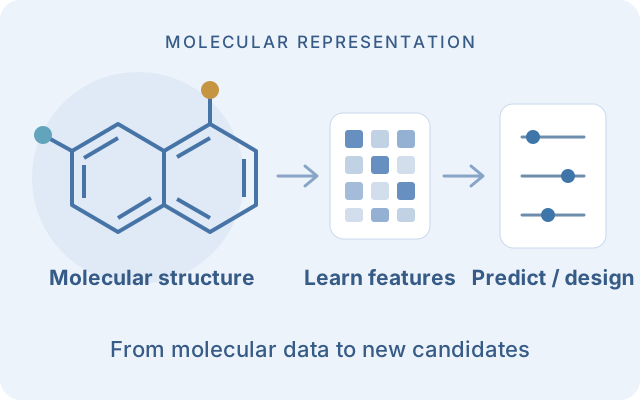
- Data
- Chemical structures, biological activity, and RNA structures
- Methods
- Molecular representation learning, deep learning, and generative models
- Goal
- Identify candidates for experimental testing and design new molecules
On this page
Drug discovery requires searching large numbers of compounds for promising candidates. We study computational methods that interpret molecular information to help identify candidates for experimental testing. Our interests extend from evaluating existing compounds to designing new molecules and exploring RNA as a drug target.
Learning properties from molecular structures
To predict a compound’s properties, its molecular structure must be represented in a form that machine learning can process. We developed a method based on SMILES, a notation that represents chemical structures as strings, and a convolutional neural network (CNN) that automatically learns structural features useful for prediction.
We evaluated this approach on the Tox21 dataset, which contains toxicity-related activity data, and demonstrated its usefulness for compound classification. We also extracted chemical motifs: substructures that contribute to classification. This work helps investigate not only a model’s predictions, but also which parts of a molecule provide useful clues.
Publication: Hirohara et al., 2018 · Open-access article
From screening candidates to designing molecules
Virtual screening uses computational predictions of molecular properties or interactions with a target to narrow down candidate compounds. Beyond screening known compounds, proposing new molecules with desired properties could expand the search space.
We aim to develop deep generative methods for proposing previously unknown compounds. Combining molecular generation with property prediction can help design candidates for experiments. Computational proposals are a starting point for drug discovery; their efficacy and safety must be established experimentally.
Exploring RNA structure for drug discovery
The RNA structure analysis methods developed in our bioinformatics research also provide a foundation for drug discovery. Studying RNA structures and their interactions with small molecules can offer clues for finding compounds that alter RNA function.
One direction we aim to pursue is identifying changes in RNA structure before and after treatment with a compound. Using structural analysis based on nanopore sequencing, we seek to connect such changes with the inference of unknown RNA functions and the identification of potential RNA drug targets.
Our review of RNA structure prediction and RNA drug discovery discusses machine learning methods and the challenges that remain.